Bradfer-Lawrence, Tom, Camille Desjonqueres, Alice Eldridge, Alison Johnston, and Oliver Metcalf. 2023.
“Using Acoustic Indices in Ecology: Guidance on Study Design, Analyses and Interpretation.” Methods in Ecology and Evolution n/a (n/a).
https://doi.org/10.1111/2041-210X.14194.
Gibb, Rory, Ella Browning, Paul Glover-Kapfer, and Kate E. Jones. 2019.
“Emerging Opportunities and Challenges for Passive Acoustics in Ecological Assessment and Monitoring.” Methods in Ecology and Evolution 10 (2): 169–85.
https://doi.org/10.1111/2041-210X.13101.
Gibbs, James P., Howard L. Snell, and Charlotte E. Causton. 1999.
“Effective Monitoring for Adaptive Wildlife Management: Lessons from the Galápagos Islands.” The Journal of Wildlife Management 63 (4): 1055–65.
https://doi.org/10.2307/3802825.
Hill, Andrew P., Peter Prince, Evelyn Piña Covarrubias, C. Patrick Doncaster, Jake L. Snaddon, and Alex Rogers. 2018.
“AudioMoth: Evaluation of a Smart Open Acoustic Device for Monitoring Biodiversity and the Environment.” Methods in Ecology and Evolution 9 (5): 1199–1211.
https://doi.org/10.1111/2041-210X.12955.
Kahl, Stefan, Connor M. Wood, Maximilian Eibl, and Holger Klinck. 2021.
“BirdNET: A Deep Learning Solution for Avian Diversity Monitoring.” Ecological Informatics 61: 101236.
https://doi.org/10.1016/j.ecoinf.2021.101236.
Kitzes, Justin, and Lauren Schricker. 2019.
“The Necessity, Promise and Challenge of Automated Biodiversity Surveys.” Environmental Conservation 46 (4): 247–50.
https://doi.org/10.1017/S0376892919000146.
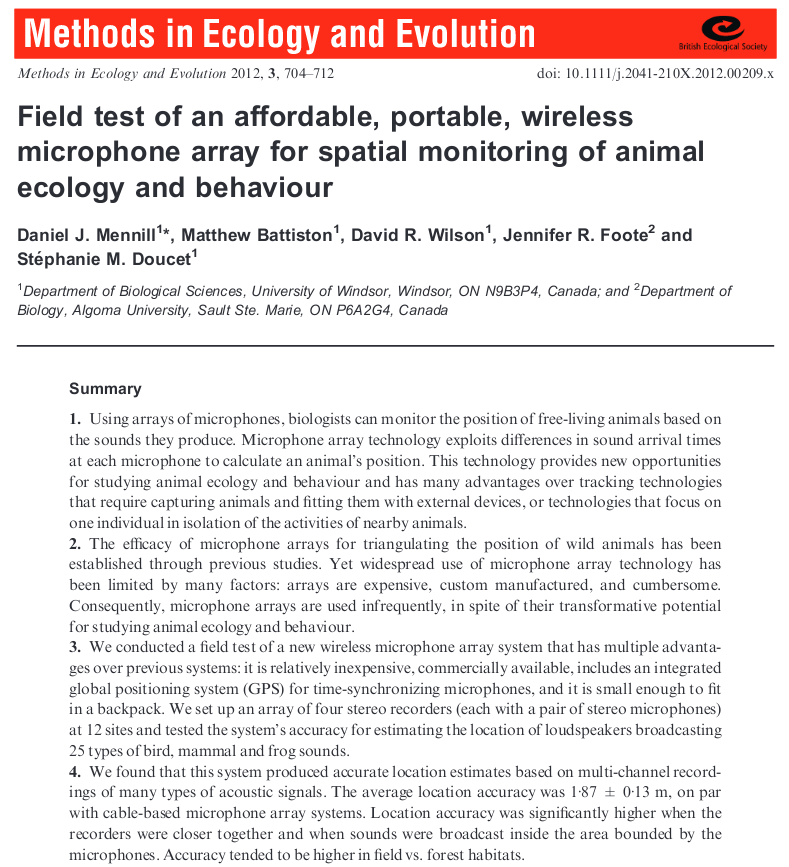
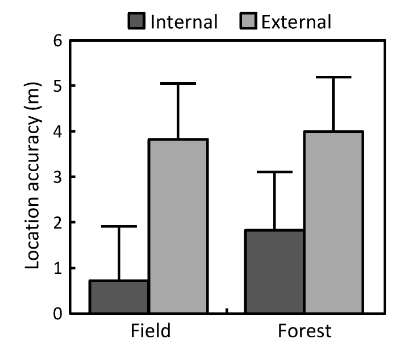
Mennill, Daniel J., Matthew M. Battiston, David R. Wilson, Jennifer R. Foote, and Stéphanie M. Doucet. 2012.
“Field Test of an Affordable, Portable, Wireless Microphone Array for Spatial Monitoring of Animal Ecology and Behaviour.” Methods in Ecology and Evolution 3 (4): 704–12.
https://doi.org/10.1111/j.2041-210x.2012.00209.x.
Rhinehart, Tessa A., Lauren M. Chronister, Trieste Devlin, and Justin Kitzes. 2020.
“Acoustic Localization of Terrestrial Wildlife: Current Practices and Future Opportunities.” Ecology and Evolution 10 (13): 6794–6818.
https://doi.org/10.1002/ece3.6216.
Tuia, Devis, Benjamin Kellenberger, Sara Beery, Blair R. Costelloe, Silvia Zuffi, Benjamin Risse, Alexander Mathis, et al. 2022.
“Perspectives in Machine Learning for Wildlife Conservation.” Nature Communications 13 (1): 792.
https://doi.org/10.1038/s41467-022-27980-y.
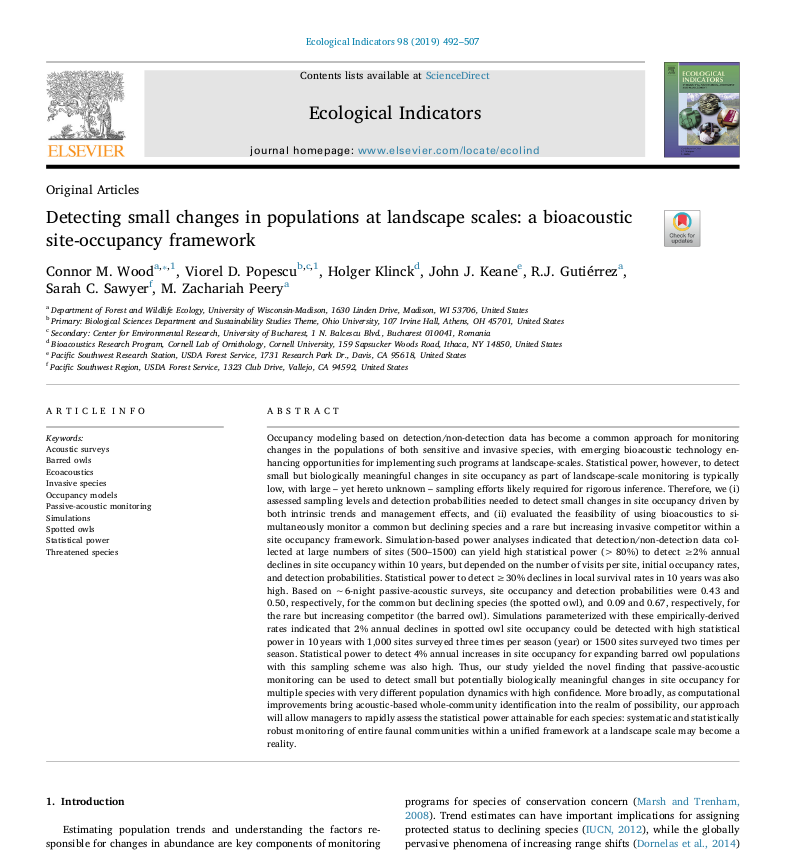
Wood, Connor M., Viorel D. Popescu, Holger Klinck, John J. Keane, R. J. Gutiérrez, Sarah C. Sawyer, and M. Zachariah Peery. 2019.
“Detecting Small Changes in Populations at Landscape Scales: A Bioacoustic Site-Occupancy Framework.” Ecological Indicators 98 (March): 492–507.
https://doi.org/10.1016/j.ecolind.2018.11.018.
Zwerts, Joeri A., P. J. Stephenson, Fiona Maisels, Marcus Rowcliffe, Christos Astaras, Patrick A. Jansen, Jaap van der Waarde, et al. 2021.
“Methods for Wildlife Monitoring in Tropical Forests: Comparing Human Observations, Camera Traps, and Passive Acoustic Sensors.” Conservation Science and Practice 3 (12): e568.
https://doi.org/10.1111/csp2.568.